Disclosure: This content may contain affiliate links. Read my disclosure policy.
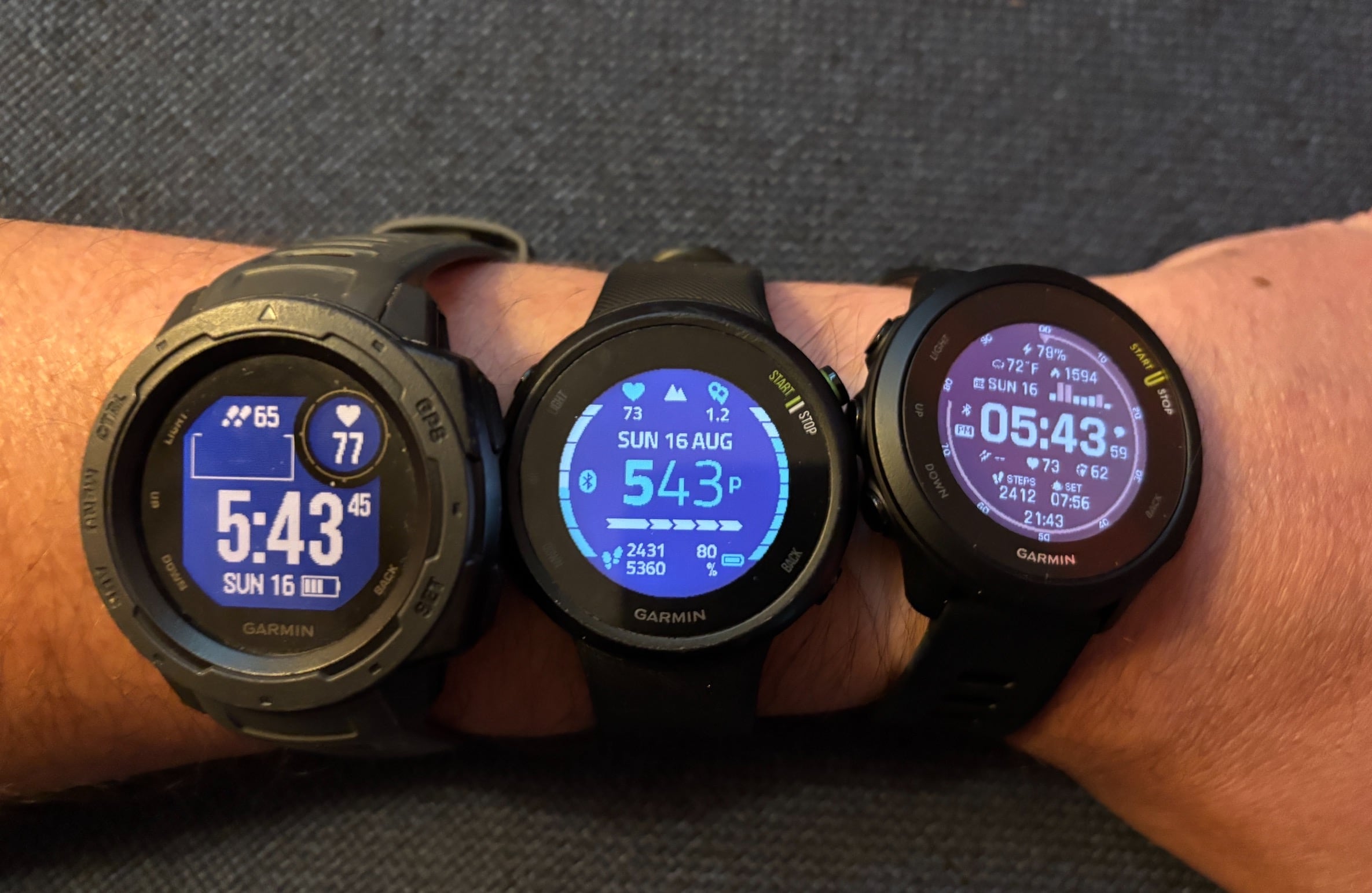
After years of comparing Garmin Instinct vs Forerunner on the trail, the latter has become my everyday watch and the one I use for most hikes.
Until recently, that was a Forerunner 45. I bought it in March 2023 and used it for a little over three years, until its aging battery started running down too quickly. I’d also subjected it to some brutally cold winter hikes, which may not have helped.
So I replaced it with a Forerunner 55.
My six-year-old Instinct, meanwhile, is still going remarkably strong. It recently crapped out after about 12½ hours on a very long hike, but that’s pretty impressive for a watch that has endured years of Catskills winters. I still use it, particularly when its ruggedness or battery life makes sense.
But for most hikes, I still choose my Forerunner.
That might seem backwards. The Instinct is Garmin’s rugged outdoor watch, while the Forerunner 55 is primarily sold as a running watch. But after years of using both, I’ve realized that most of the features that supposedly make the Instinct a better hiking watch aren’t features I actually need.
TL;DR: Don’t buy the watch designed for the identity of “hiker.” Buy the watch whose features correspond to what you actually need and enjoy.
For me, that watch is the Forerunner.
Garmin Instinct vs Forerunner 55
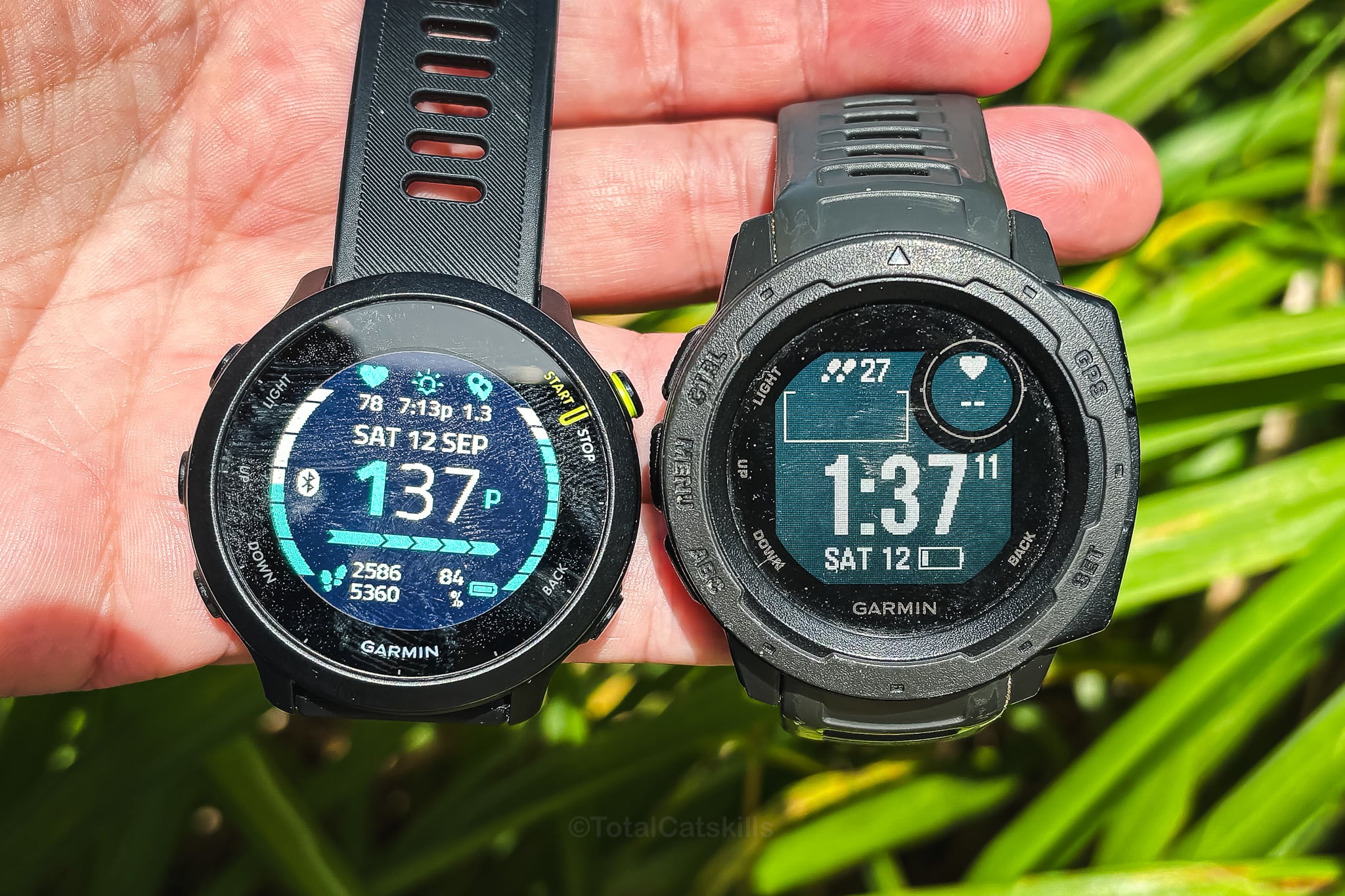
The Garmin Instinct is designed as a rugged outdoor watch. The Forerunner 55 is designed primarily as a running watch.
On paper, the choice for a hiker seems obvious.
The Instinct has an electronic compass, barometric altimeter and navigation features, along with a rugged case and 10 ATM water resistance. It looks and feels like an outdoor adventure watch because that’s exactly what it was designed to be.
The Forerunner 55 is smaller and lighter. At 37 grams, it weighs 15 grams less than my original Instinct. It has a 208 × 208 color display rather than the Instinct’s 128 × 128 monochrome display, and its feature set is oriented more toward running, fitness and recovery.
But these specifications only matter if you use them. I don’t.
What I Actually Need From a Hiking Watch
Primarily, I need my watch to record my hike.
I want a good GPS track. I want distance, time and heart-rate data. I want to know how hard I worked, and I want the activity recorded afterward in Garmin Connect.
I don’t depend on my watch for navigation. For that, I use proper hiking maps on my phone, downloaded ahead of time so I’m not dependent on cell service. I also carry paper maps as backup. Those tools give me far more useful navigational information than I need from a tiny screen on my wrist.
That makes some of the Instinct’s headline outdoor features much less important to me. I have an electronic compass on the Instinct. I never use it. I mean, does anyone really use or trust their watch for backcountry nav?
And then there’s the barometric altimeter.
BTW, you might also enjoy…
- CATSKILLS › Catskills Fall Foliage 2026
- ADIRONDACKS › Hike Cascade & Porter
- STAY › Find Your Perfect Catskills Stay
- UPDATED › Best Bug Spray & Repellent for Hikers
- LEARN › Camping in the Catskills
- Follow › My Instagram @TotalCatskills
- Follow › My Substack @TotalCatskills
- Follow › My writing for Times Union
My Instinct’s Barometric Altimeter Failed Years Ago
A barometric altimeter sounds exactly like something a serious hiker should want. Elevation is fundamental to understanding mountain terrain, so having an altimeter built into your hiking watch sounds useful.
Mine is trash.
The barometric altimeter in my Instinct went haywire years ago, and none of the recommended fixes I found online ever restored it. It now produces absurd results. I can finish a hike with roughly 2,000 feet of actual elevation gain and have the Instinct tell me I climbed something like 7,000 feet.
I’m not claiming that Garmin barometric altimeters are inherently unreliable. I’m saying mine failed and, more importantly, losing it taught me that I didn’t actually need it.
If I want to know my elevation, I can get it from my phone. When I’m navigating in the mountains, contour lines on a proper topographic map tell me where I am in relation to the terrain around me.
For some hikers and mountaineers, a functioning barometric altimeter may be genuinely useful. But I suspect plenty of recreational hikers see “barometric altimeter” on an outdoor watch’s feature list and assume it’s something a hiking watch ought to have.
I live happily without one.
Why I Prefer the Forerunner 55
Once I remove navigation, compass and barometric elevation from my requirements, the comparison changes considerably.
The Forerunner 55 is just a lot nicer for me to wear every day. It’s lighter and less bulky than the Instinct, which matters when something is strapped to your wrist from morning until night.
I also greatly prefer the color screen.
Neither watch has the brilliant touchscreen display of an Apple Watch or Garmin’s more expensive AMOLED watches. But that’s fine with me. The Forerunner 55 uses a sunlight-readable display that remains visible all the time without consuming the kind of power required by a bright AMOLED screen.
But the color display makes information easier to distinguish at a glance, and I find the Forerunner far more pleasant to use than the black-and-white Instinct.
More importantly, my hiking watch isn’t just my hiking watch.
I run. I cycle. I walk every day. I use my Garmin for general fitness tracking and heart-rate data. I want something comfortable enough to wear all day, and then I want that same watch to record a ten-hour mountain hike on the weekend.
The 55 fits me particularly well.
The Forerunner is a Training Watch, Not Just a Running Watch
Calling the Forerunner 55 a “running watch” undersells it, IMO.
Yes, running is where its feature set is strongest. It includes tools such as suggested workouts, cadence alerts, PacePro and recovery information. It also handles cycling, walking and other activities.
But some of those training features are useful for hiking too.
One I’ve found surprisingly useful is Recovery Time. After I recently hiked the Dix Range, the Forerunner 55 recommended about 3½ days of recovery before another hard effort.
84 hrs of couch time after the Dix Range? Entirely reasonable advice. This is the kind of feature I value more than a compass or barometric altimeter.
The Instinct gives me more outdoor instrumentation.
The Forerunner gives me more training instrumentation.
I get way more use from the latter.
Battery Life: My Instinct Has Been Impressive
This is one area where my 2020 Instinct deserves considerable credit.
My six-year-old Instinct recently lasted about 12½ hours during a very long hike before its battery died. That watch has also endured years of freezing winter conditions, and its battery has aged remarkably well.
My Forerunner 45 didn’t. After a little more than three years, declining battery performance was the main reason I replaced it. Repeated exposure to very cold conditions may have contributed, but I can’t know how much.
The Forerunner 55 is rated for up to 14 days in smartwatch mode and up to 20 hours in GPS mode, which is plenty for almost any single-day hike I’m likely to undertake.
One real-world wrinkle is worth knowing: third-party Connect IQ watch faces can consume additional battery power, particularly if they’re frequently updating data. If battery life matters to you, a simpler Garmin watch face may help you get closer to Garmin’s advertised smartwatch battery life.
For genuinely enormous days or multi-day adventures, however, battery endurance deserves to be high on our shopping lists. That may push you toward the Instinct family, particularly the newer versions which have much longer battery options.
When I’d Choose the Instinct Instead
There are plenty of hikers for whom the Instinct makes more sense.
If you genuinely use wrist-based navigation, want an electronic compass, rely on barometric elevation information, need 10 ATM water resistance or place a premium on rugged construction, the Instinct gives you those things.
It also feels like equipment. Mine has been knocked around, soaked, frozen and generally abused for six years, and I still trust it enough to take it into the mountains.
But those advantages need to solve problems you actually have.
For the way I hike, run, cycle and use a watch every day, I get more from the Forerunner 55.
Garmin Instinct vs Forerunner 55: Which Should You Buy?
Forget for a moment which Garmin is marketed to runners and which one looks like it belongs on a mountain. Start with what you actually want your watch to do.
| If this sounds like you… | Forerunner 55 | Instinct | Better fit |
|---|---|---|---|
| I mostly want to record my hikes | ✓✓✓ | ✓✓✓ | Either |
| I also run regularly | ✓✓✓ | ✓ | Forerunner 55 |
| I also cycle | ✓✓✓ | ✓✓ | Forerunner 55 |
| I want training and recovery information | ✓✓✓ | ✓ | Forerunner 55 |
| I want a light everyday fitness watch | ✓✓✓ | ✓ | Forerunner 55 |
| I prefer a color display | ✓✓✓ | ✗ | Forerunner 55 |
| I navigate primarily with my phone/maps | ✓✓✓ | ✓✓✓ | Forerunner 55 |
| I want navigation functions on my wrist | ✓ | ✓✓✓ | Instinct |
| I want a built-in compass | ✗ | ✓✓✓ | Instinct |
| I specifically want a barometric altimeter | ✗ | ✓✓✓ | Instinct |
| I need maximum ruggedness | ✓✓ | ✓✓✓ | Instinct |
| I want greater water resistance | ✓✓ | ✓✓✓ | Instinct |
| I regularly do extremely long days outdoors | ✓✓ | ✓✓✓ | Instinct |
| I want one watch for hiking, running, cycling and everyday fitness | ✓✓✓ | ✓✓ | Forerunner 55 |
There’s no universal winner.
The Instinct is the better choice if you genuinely need its outdoor instrumentation. I still own mine, still use it, and after six years I have considerable respect for how well it has held up.
But I don’t need most of what makes an Instinct an Instinct. I need a comfortable everyday watch that tracks my fitness, works well for running and cycling, records long mountain hikes, and gives me useful information about the physical effort I’m putting in. For that job, I prefer the Forerunner 55.
Don’t buy the watch designed for the identity of “hiker.” Buy the watch whose features correspond to what you actually do.
Mountain-Hiking.com is independently owned and supported by readers and a small group of sponsors. If you’d like to help me continue producing articles like this, please consider becoming a Patreon supporter.
More Good Stuff
Get full access…
Get instant access to the full version of this site and enjoy great supporter benefits: full galleries, full trail notes, early access to the latest content, and more.
Hot on the website right now…
Follow for more…
Follow my @TotalCatskills content on Instagram for regular hiking inspo and safe, inclusive community.